Analysis in progress
Initialising…
0%
complete
This report is still being assembled — sections appear as each stage finishes. It isn't final yet.
ATM
Final classification
VUS
ATM c.3080A>G · p.His1027Arg
ATM

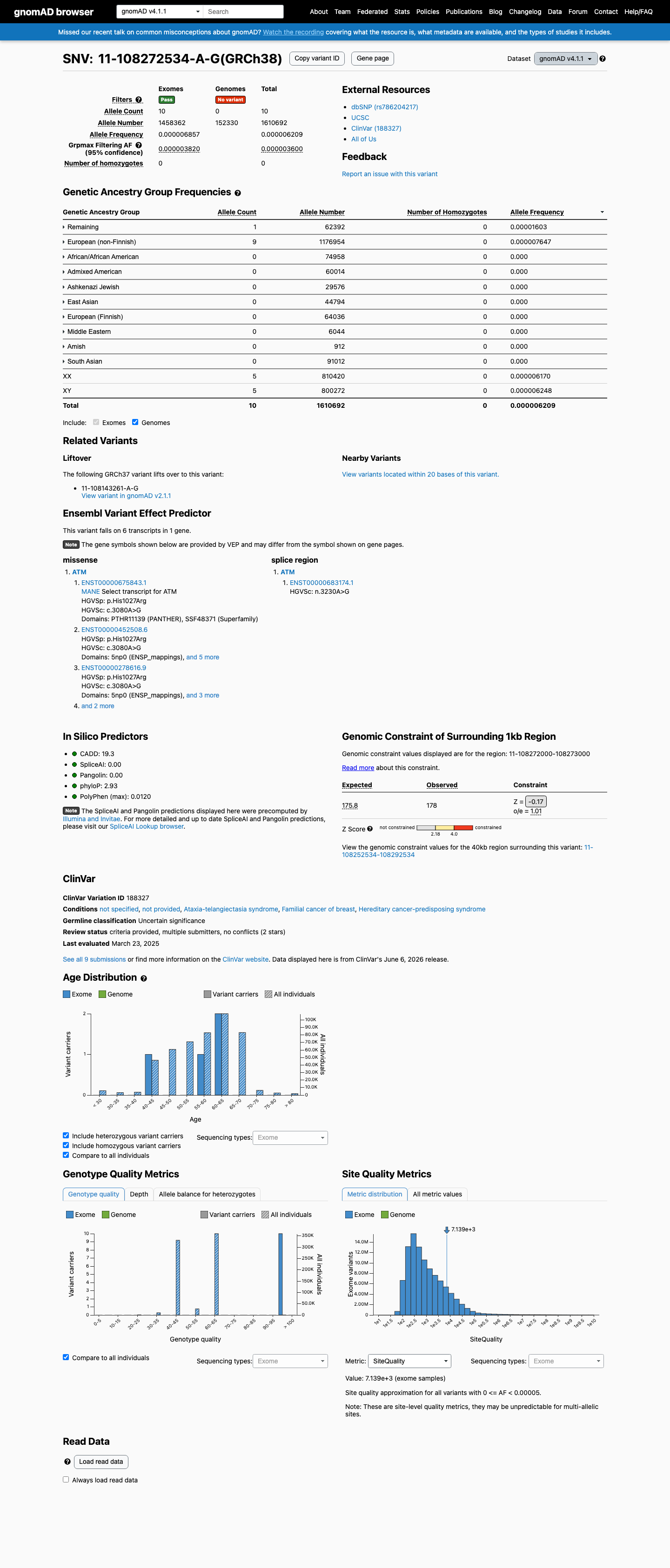
PM2 (Supporting): the variant is extremely rare in population databases - gnomAD v4.1 total allele frequency 0.00062% and grpmax FAF 0.00036%, both at or below the 0.001% supporting threshold, with no homozygotes.

Gene
ATM
Transcript
NM_000051.4
HGVS · transcript:coding
NM_000051.4:c.3080A>G
Consequence
N/A
GRCh38
chr11:108272534 A>G
GRCh37
chr11:108143261 A>G
Basis The primary authority was the ClinGen Hereditary Breast, Ovarian and Pancreatic Cancer Expert Panel specification to the ACMG/AMP guidelines for ATM, version 1.5. Exactly one criterion was met: PM2 at supporting strength, because the variant is extremely rare in population databases (gnomAD v4.1 total allele frequency 0.00062% and grpmax FAF 0.00036%, both at or below the 0.001% threshold, with no homozygotes). All other criteria were not met, not applicable under the specification, or could not be assessed for lack of evidence. Because PM2 supporting alone matches no Pathogenic, Likely Pathogenic, Benign, Likely Benign, or conflicting-evidence rule in the specification, the variant remains a Variant of Uncertain Significance.
The primary authority was the ClinGen Hereditary Breast, Ovarian and Pancreatic Cancer Expert Panel specification to the ACMG/AMP guidelines for ATM, version 1.5. Exactly one criterion was met: PM2 at supporting strength, because the variant is extremely rare in population databases (gnomAD v4.1 total allele frequency 0.00062% and grpmax FAF 0.00036%, both at or below the 0.001% threshold, with no homozygotes). All other criteria were not met, not applicable under the specification, or could not be assessed for lack of evidence. Because PM2 supporting alone matches no Pathogenic, Likely Pathogenic, Benign, Likely Benign, or conflicting-evidence rule in the specification, the variant remains a Variant of Uncertain Significance.
Classification rationale
PM2 VUS
ATM c.3080A>G

PM2 (Supporting): the variant is extremely rare in population databases - gnomAD v4.1 total allele frequency 0.00062% and grpmax FAF 0.00036%, both at or below the 0.001% supporting threshold, with no homozygotes. With PM2 (Supporting) as the only met criterion, no Pathogenic, Likely Pathogenic, Benign, Likely Benign, or conflicting-evidence rule is triggered, so the variant is classified as a Variant of Uncertain Significance (VUS).

PM2 VUS
Gene diagram · NM_000051.4 · variants mapped to exon structure
ATM NM_000051.4
Fetching transcript structure from UCSC…
Applied criteria · 1 applied · 11 assessed
Applied · 1
Strength Supporting Moderate Strong Very strong
PM2 supporting Pathogenic
PM2 (Supporting) is met: the variant is extremely rare. gnomAD v4.1 total allele frequency is 0.00062% (10/1,610,692 alleles, no homozygotes) with a grpmax filtering allele frequency of 0.00036%, both at or below the specification's 0.001% threshold; rarity is corroborated by gnomAD v2.1 (0.00040%) and absence from gnomAD-Canada.
gnomAD v4.1 total AF 6.21e-06 (0.00062%, 10/1,610,692, 0 homozygotes)gnomAD v4.1 grpmax FAF 3.6e-06 (0.00036%)gnomAD v4.1 'Remaining individuals' subpopulation n=1/62,392 (satisfies VCEP n=1 clause)
Assessed · not applied
Pathogenic
PS1 PS1 requires the same amino acid change to have been established as pathogenic (or likely pathogenic) in another variant.
PS3 PS3 can only be applied through functional assays approved by the ATM expert panel (three kinase-activity assays and one radiosensitivity assay).
PS4 No case-control or cohort enrichment data exist for this variant.
PM3 PM3 requires observations of the variant in ataxia-telangiectasia probands carrying a second ATM variant.
PP1 PP1 requires segregation of the variant in affected relatives, with both variants identified in the proband.
PP3 PP3 is not met on either computational path calibrated by the ATM specification: REVEL is 0.349, well below the >0.7333 pathogenic threshold, and SpliceAI max delta is 0.05, below the >=0.2 threshold.
Benign
BA1 BA1 is not met: it requires a grpmax filtering allele frequency above 0.5%, and the observed grpmax FAF is 0.00036% - more than a thousand-fold below the threshold, with no homozygotes and no ancestry-specific enrichment.
BS1 BS1 is not met: it requires a grpmax filtering allele frequency above 0.05%, and the observed grpmax FAF of 0.00036% is roughly 140-fold lower.
BS3 BS3 requires demonstration that the variant does not damage ATM function in a panel-approved assay.
BP2 BP2 requires observations of unaffected carriers who carry this variant in trans with a pathogenic ATM variant (or evidence of a cis configuration).
BP4 BP4 is not met: under the rule as applied, missense variants are evaluated only on the REVEL threshold (<= 0.249), and REVEL is 0.349 - above the threshold and inside the specification's gray zone.
N/A · 16 PVS1 · PS2 · PM1 · PM4 · PM5 · PM6 · PP2 · PP4 · PP5 · BS2 · BS4 · BP1 · BP3 · BP5 · BP6 · BP7
Research & evidence
Population frequency
gnomAD v4.1 screenshot
gnomAD v4.1
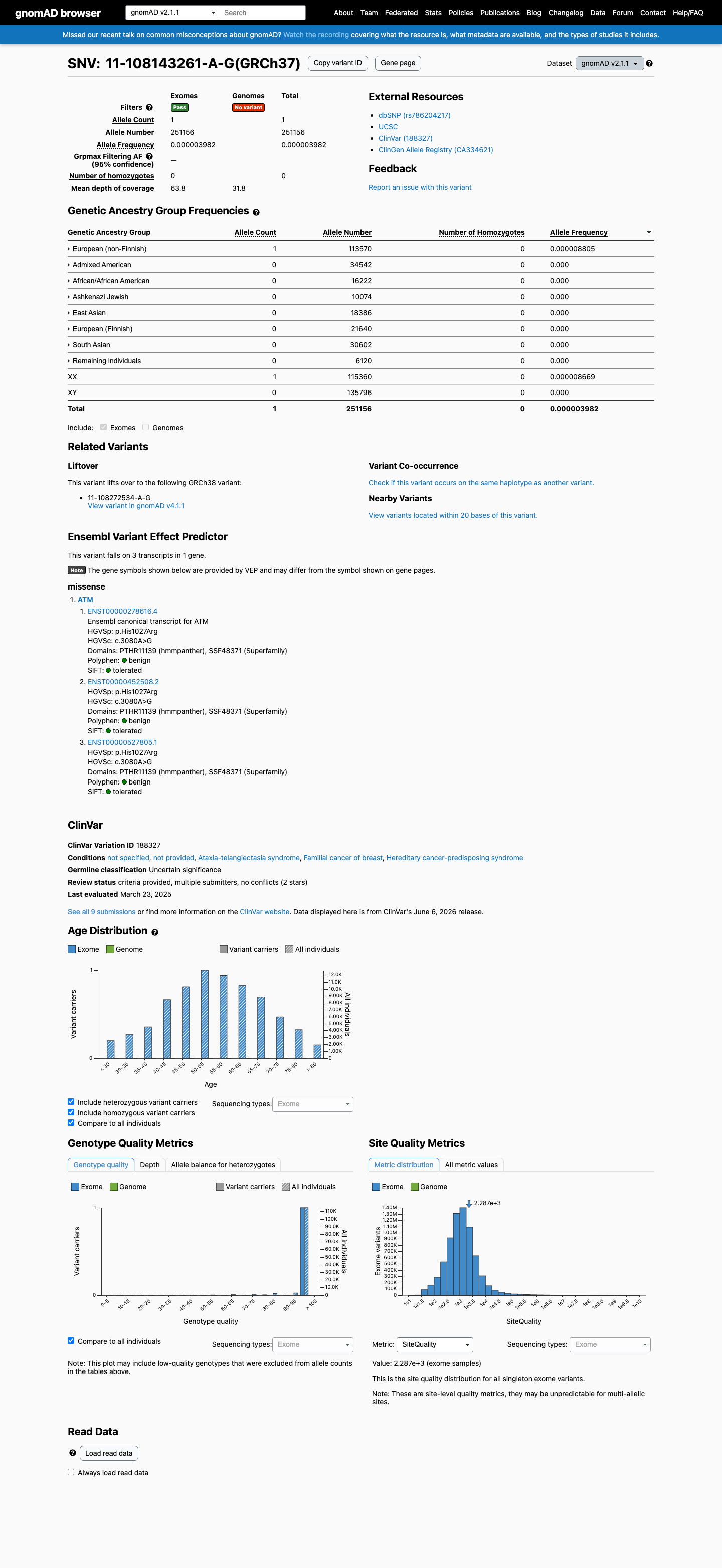
gnomAD v2.1 screenshot
gnomAD v2.1
v4.1
This variant is present in gnomAD v4.1 (AF= 6.20851e-06; MAF= 0.00062%, 10/1610692 alleles, homozygotes = 0) and has highest observed frequency in the Remaining individuals population (AF= 1.60277e-05; MAF= 0.00160%, 1/62392 alleles, homozygotes = 0); grpmax FAF= 3.6e-06.
v2.1
This variant is present in gnomAD v2.1 (AF= 3.98159e-06; MAF= 0.00040%, 1/251156 alleles, homozygotes = 0) and has highest observed frequency in the European (non-Finnish) population (AF= 8.80514e-06; MAF= 0.00088%, 1/113570 alleles, homozygotes = 0).
🇨🇦 CA
Absent from gnomAD-Canada v1.0.
Allele frequency by ancestry
three datasets · side by side
gnomAD v4.1
0.00062% · 10 / 1,610,692
0 hom · FAF 0.00036%
Remaining individuals
1 / 62,392
0.0016%
European (non-Finnish)
9 / 1,176,954
0.00076%
+ 8 not observed (Admixed American, European (Finnish), Amish, East Asian, Middle Eastern, South Asian, Ashkenazi Jewish, African/African American)
gnomAD v2.1
0.0004% · 1 / 251,156
0 hom
European (non-Finnish)
1 / 113,570
0.00088%
+ 7 not observed (African/African American, Admixed American, Ashkenazi Jewish, East Asian, European (Finnish), Remaining individuals, South Asian)
gnomAD Canada 🇨🇦
Absent · 0 / ?
0 hom
Not observed in any ancestry group.
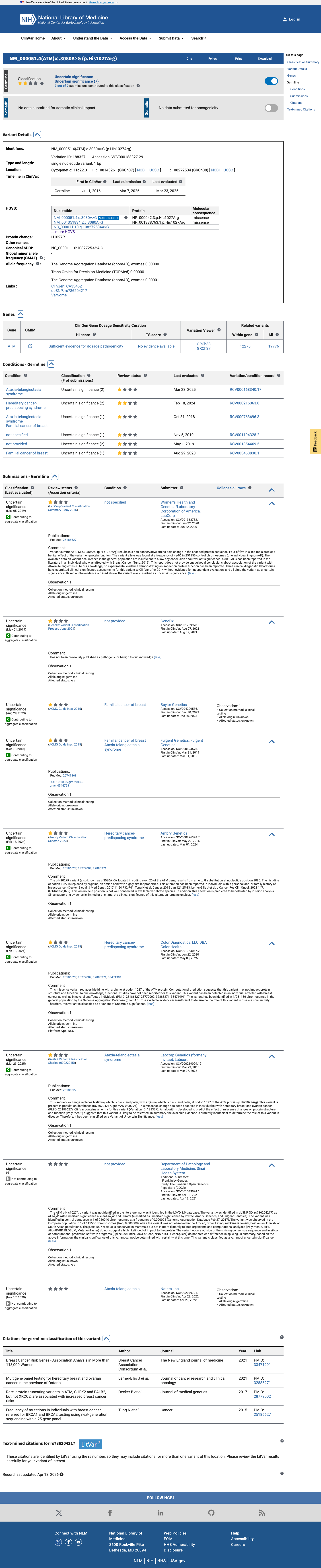
ClinVar screenshot
ClinVar
This variant has been reported in ClinVar as Uncertain significance (9 clinical laboratories). (ClinVarID = 188327)
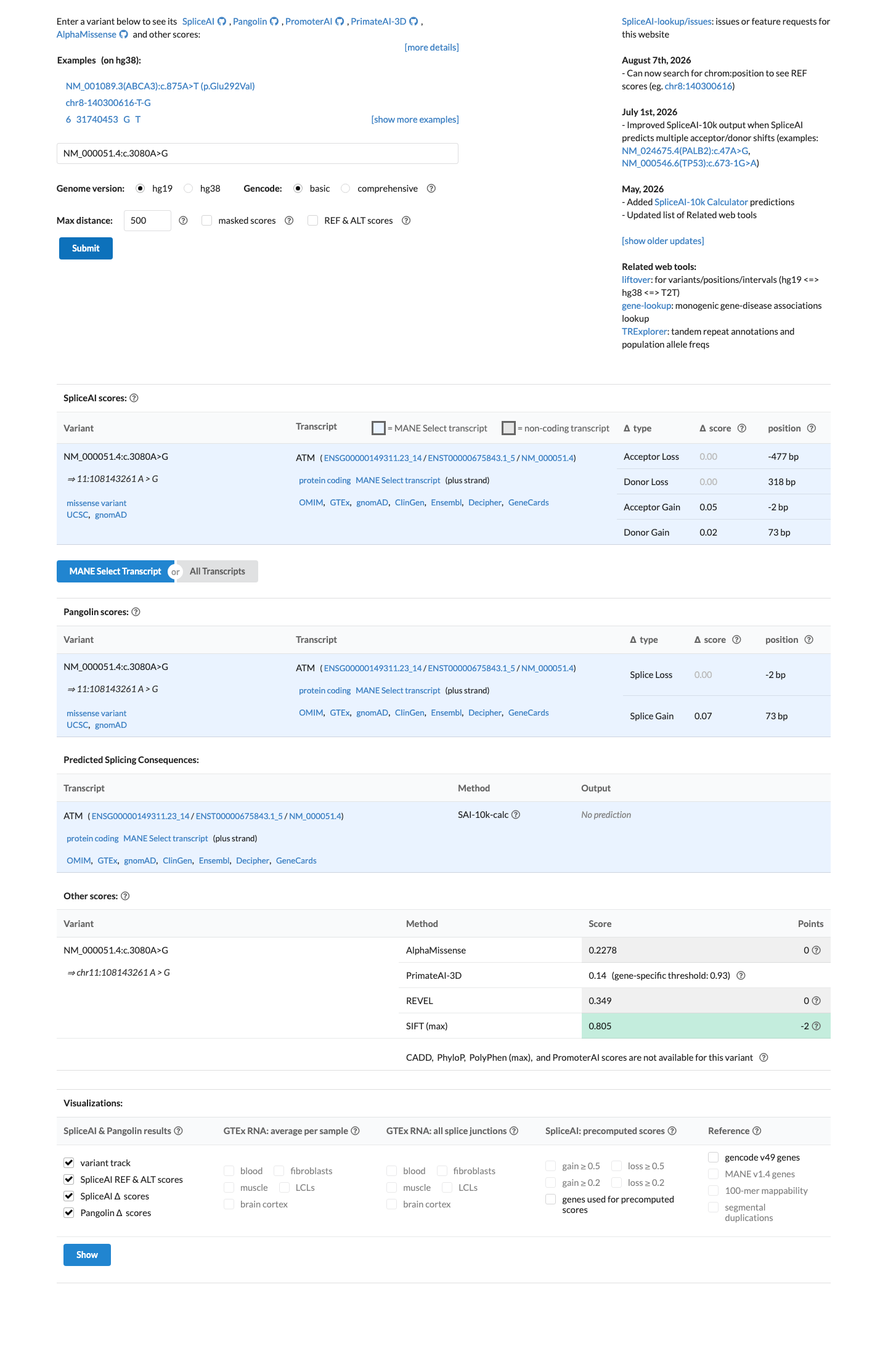
SpliceAI screenshot
In silico
SpliceAI predicts no significant splice impact for this variant (max delta score = 0.05). REVEL score = 0.349. BayesDel score = -0.237229.
Functional / OncoKB screenshot
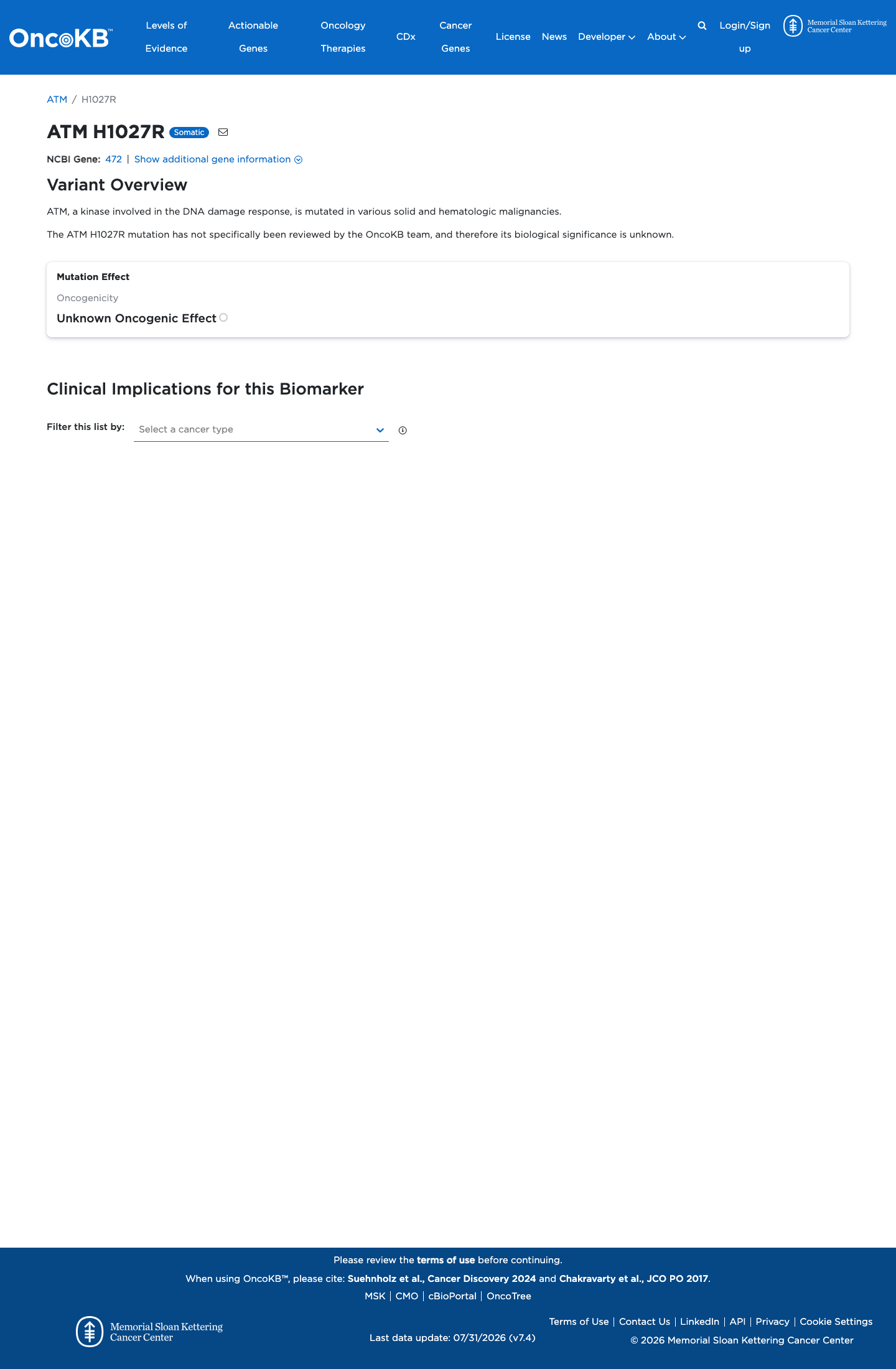
Functional Unknown Oncogenic Effect
OncoKB did not identify variant-specific reviewed functional evidence for this variant; gene-level curated context is available for reviewer follow-up. ATM, a kinase involved in the DNA damage response, is mutated in various solid and hematologic malignancies.
OncoKB ↗
COSMIC screenshot
COSMIC
Cancer hotspots screenshot
Cancer hotspots
Somatic evidence Not in COSMIC / hotspots
COSMIC
This variant does not lie in a statistically significant hotspot. This variant has not previously been reported in somatic cancers (COSMIC).
Hotspots
This variant does not lie in a statistically significant hotspot.
Sources & reference links
9Sources
CSpec VCEP
ClinVar
gnomAD v2.1
gnomAD v4.1
gnomAD-Canada
SpliceAI
OncoKB
COSMIC
Cancer hotspots
Triaged references · 8 PMIDs not cited in assessment
25741868 ↗ Standards and guidelines for the interpretation of sequence variants: a joint consensus recommendation of the American College of Medical Genetics and Genomics and the Association for Molecular Pathology. CLINVAR
28779002 ↗ Rare, protein-truncating variants in ATM, CHEK2 and PALB2, but not XRCC2, are associated with increased breast cancer risks. CLINVAR
34242744 ↗ Customizing local and systemic therapies for women with early breast cancer: the St. Gallen International Consensus Guidelines for treatment of early breast cancer 2021. CLINVAR
17508274 ↗ Risk assessment and genetic counseling for hereditary breast and ovarian cancer: recommendations of the National Society of Genetic Counselors. CLINVAR
20301317 ↗ Hereditary Ataxia Overview. CLINVAR
25186627 ↗ Frequency of mutations in individuals with breast cancer referred for BRCA1 and BRCA2 testing using next-generation sequencing with a 25-gene panel. CLINVAR
26389210 ↗ Genetics of Breast and Gynecologic Cancers (PDQ®): Health Professional Version. CLINVAR
32885271 ↗ Multigene panel testing for hereditary breast and ovarian cancer in the province of Ontario. CLINVAR