Analysis in progress
Initialising…
0%
complete
This report is still being assembled — sections appear as each stage finishes. It isn't final yet.
MSH6
Final classification
VUS
MSH6 c.4001+32_4001+35dup · p.?
MSH6

BP7 (Supporting): intronic variant at +32 to +35, beyond the VCEP -21/+7 boundary.

Gene
MSH6
Transcript
NM_000179.3
HGVS · transcript:coding
NM_000179.3:c.4001+32_4001+35dup
Consequence
N/A
GRCh38
chr2:47806677 A>ATAAC
GRCh37
chr2:48033816 A>ATAAC
Basis VUS: only BP7 (Supporting) is met (intronic variant at +32 to +35, beyond the +7 boundary), below the two-criterion minimum for Likely Benign. Flagged for human review: BS1 missed its gnomAD frequency floor by a narrow margin, and confirming it would change the call to Likely Benign.
VUS: only BP7 (Supporting) is met (intronic variant at +32 to +35, beyond the +7 boundary), below the two-criterion minimum for Likely Benign. Flagged for human review: BS1 missed its gnomAD frequency floor by a narrow margin, and confirming it would change the call to Likely Benign.
Classification rationale
BP7 VUS
MSH6 c.4001+32_4001+35dup

BP7 (Supporting): intronic variant at +32 to +35, beyond the VCEP -21/+7 boundary. Overall: VUS — one Benign Supporting criterion alone matches no combination rule; Likely Benign would require at least two Supporting criteria or a Strong plus a Supporting.

BP7 VUS
Gene diagram · NM_000179.3 · variants mapped to exon structure
MSH6 NM_000179.3
Fetching transcript structure from UCSC…
Applied criteria · 1 applied · 15 assessed
Applied · 1
Strength Supporting Moderate Strong Very strong
BP7 supporting Benign
Met (Supporting): intronic variant at +32 to +35, beyond the VCEP -21/+7 boundary.
CSPEC InSiGHT MSH6 v2.0 BP7 rule: synonymous (silent) or intronic variant at or beyond -21/+7 (5'/3' exonic)Variant position: c.4001+32_4001+35dup = intron 9, +32 to +35 downstream of the exon (beyond +7)
Assessed · not applied
Pathogenic
PVS1 Not met: this deep intronic duplication (intron 9, +32 to +35) creates no premature stop codon and matches no VCEP PVS1 tier.
PS2 Not assessed: no de novo occurrence or parental-testing data were available to score.
PS3 Not assessed: no calibrated functional assay, MMR function test, or mRNA expression data were available.
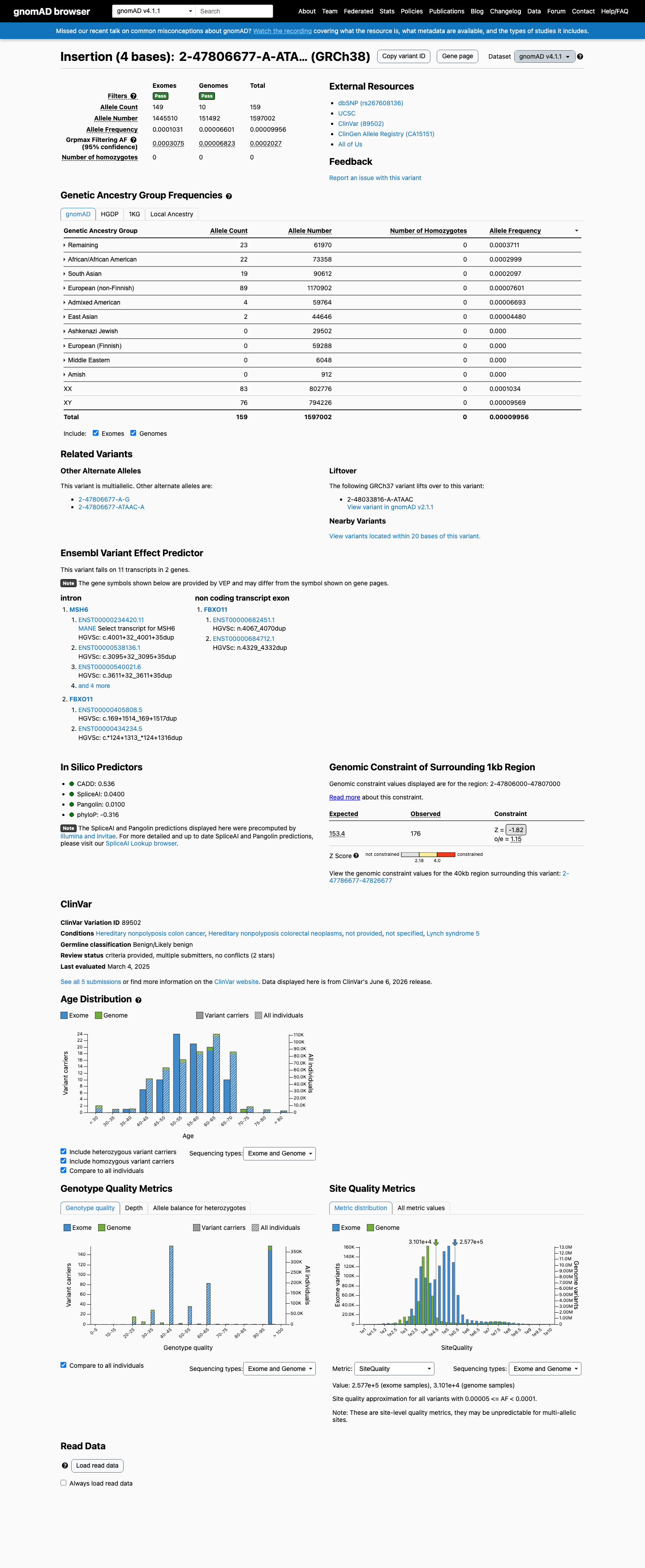
PM2 Not met: gnomAD v4.1 allele frequency 0.00996% (159/1,597,002 alleles) is about 5-fold above the <0.002% threshold.
PM3 Not assessed: no second MSH6 variant, phase testing, or CMMRD-consistent clinical features were available to score co-occurrence.
PP1 Not assessed: no pedigree or co-segregation data were available to compute a likelihood ratio.
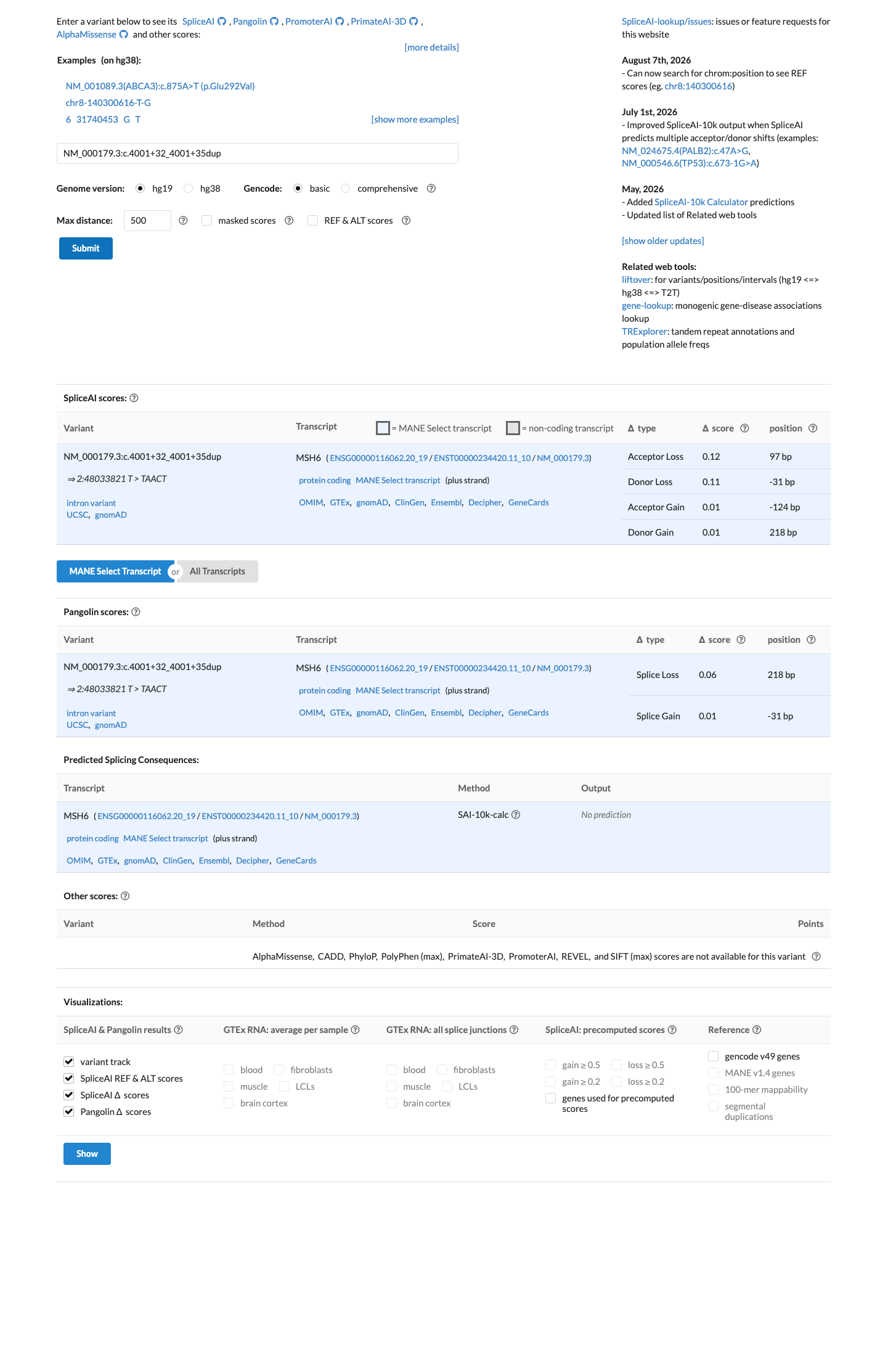
PP3 Not met: SpliceAI max delta 0.12 is below the >=0.2 PP3 splice threshold, and the variant is not a missense.
PP4 Not assessed: no MSI status, MMR-immunohistochemistry results, or tumor-phenotype case reports were available.
Benign
BA1 Not met: gnomAD v4.1 grpmax FAF 0.0203% is an order of magnitude below the 0.22% BA1 threshold.
BS1 Not met: joint-callset grpmax FAF 0.0203% sits just below the 0.022% BS1 floor.
BS2 Not assessed: no phase-confirmed trans co-occurrence with a pathogenic MSH6 variant in a compatible patient was available.
BS3 Not assessed: no mRNA/cDNA assay or calibrated functional results were available for this intronic variant.
BS4 Not assessed: no pedigree-based non-segregation observations were available to compute a likelihood ratio.
BP4 Not met: SpliceAI max delta 0.12 exceeds the <=0.1 BP4 cutoff.
BP5 Not assessed: no MSS, MMR-immunohistochemistry, or BRAF V600E/MLH1-methylation tumor data were available.
N/A · 12 PS1 · PS4 · PM1 · PM4 · PM5 · PM6 · PP2 · PP5 · BP1 · BP2 · BP3 · BP6
Research & evidence
Population frequency
gnomAD v4.1 screenshot
gnomAD v4.1
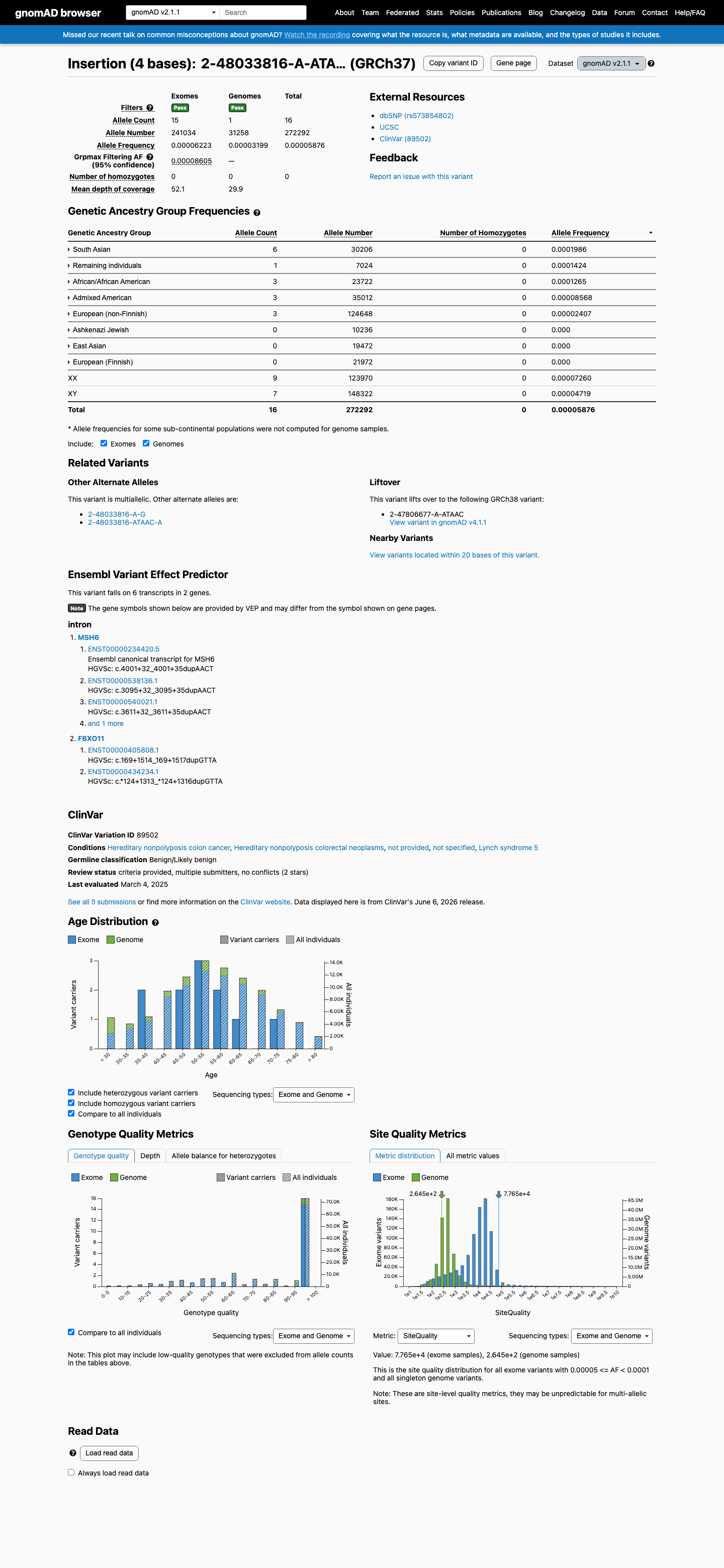
gnomAD v2.1 screenshot
gnomAD v2.1
v4.1
This variant is present in gnomAD v4.1 (AF= 9.95616e-05; MAF= 0.00996%, 159/1597002 alleles, homozygotes = 0) and has highest observed frequency in the Remaining individuals population (AF= 0.000371147; MAF= 0.03711%, 23/61970 alleles, homozygotes = 0); grpmax FAF= 0.00020269.
v2.1
This variant is present in gnomAD v2.1 (AF= 5.87604e-05; MAF= 0.00588%, 16/272292 alleles, homozygotes = 0) and has highest observed frequency in the South Asian population (AF= 0.000198636; MAF= 0.01986%, 6/30206 alleles, homozygotes = 0); grpmax FAF= 8.605e-05.
🇨🇦 CA
Not available in gnomAD-Canada v1.0.
Allele frequency by ancestry
three datasets · side by side
gnomAD v4.1
0.01% · 159 / 1,597,002
0 hom · FAF 0.02%
Remaining individuals
23 / 61,970
0.037%
African/African American
22 / 73,358
0.03%
South Asian
19 / 90,612
0.021%
European (non-Finnish)
89 / 1,170,902
0.0076%
Admixed American
4 / 59,764
0.0067%
East Asian
2 / 44,646
0.0045%
+ 4 not observed (European (Finnish), Amish, Middle Eastern, Ashkenazi Jewish)
gnomAD v2.1
0.0059% · 16 / 272,292
0 hom · FAF 0.0086%
South Asian
6 / 30,206
0.02%
Remaining individuals
1 / 7,024
0.014%
African/African American
3 / 23,722
0.013%
Admixed American
3 / 35,012
0.0086%
European (non-Finnish)
3 / 124,648
0.0024%
+ 3 not observed (Ashkenazi Jewish, East Asian, European (Finnish))
gnomAD Canada 🇨🇦
Absent · 0 / ?
0 hom
Not observed in any ancestry group.
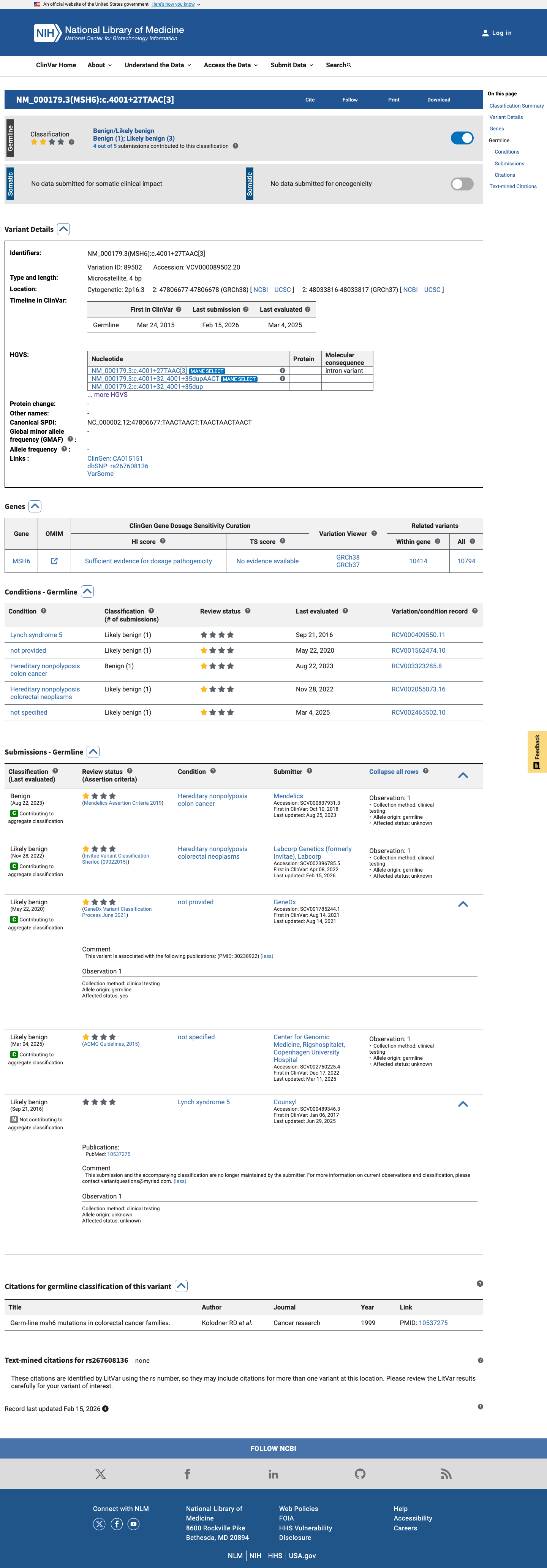
ClinVar screenshot
ClinVar
This variant has been reported in ClinVar as Likely benign (4 clinical laboratories) and as Benign (1 clinical laboratory). (ClinVarID = 89502)
SpliceAI screenshot
In silico
SpliceAI predicts no significant splice impact for this variant (max delta score = 0.12).
Functional No data
No calibrated functional assay or RNA evidence was identified for this variant.
OncoKB ↗
COSMIC screenshot
COSMIC
Somatic evidence
COSMIC
This variant has not previously been reported in somatic cancers (COSMIC).
Hotspots
This variant does not lie in a statistically significant cancer hotspot.
COSMIC ↗
Sources & reference links
8Sources
CSpec VCEP
ClinVar
gnomAD v2.1
gnomAD v4.1
gnomAD-Canada
SpliceAI
OncoKB
COSMIC
Triaged references · 8 PMIDs not cited in assessment
10537275 ↗ Germ-line msh6 mutations in colorectal cancer families. CLINVAR
25741868 ↗ Standards and guidelines for the interpretation of sequence variants: a joint consensus recommendation of the American College of Medical Genetics and Genomics and the Association for Molecular Pathology. CLINVAR
20301390 ↗ Lynch Syndrome. CLINVAR
23788249 ↗ ACMG recommendations for reporting of incidental findings in clinical exome and genome sequencing. CLINVAR
34012068 ↗ ACMG SF v3.0 list for reporting of secondary findings in clinical exome and genome sequencing: a policy statement of the American College of Medical Genetics and Genomics (ACMG). CLINVAR
34043773 ↗ European guidelines from the EHTG and ESCP for Lynch syndrome: an updated third edition of the Mallorca guidelines based on gene and gender. CLINVAR
35802134 ↗ ACMG SF v3.1 list for reporting of secondary findings in clinical exome and genome sequencing: A policy statement of the American College of Medical Genetics and Genomics (ACMG). CLINVAR
28492532 ↗ Sherloc: a comprehensive refinement of the ACMG-AMP variant classification criteria. CLINVAR